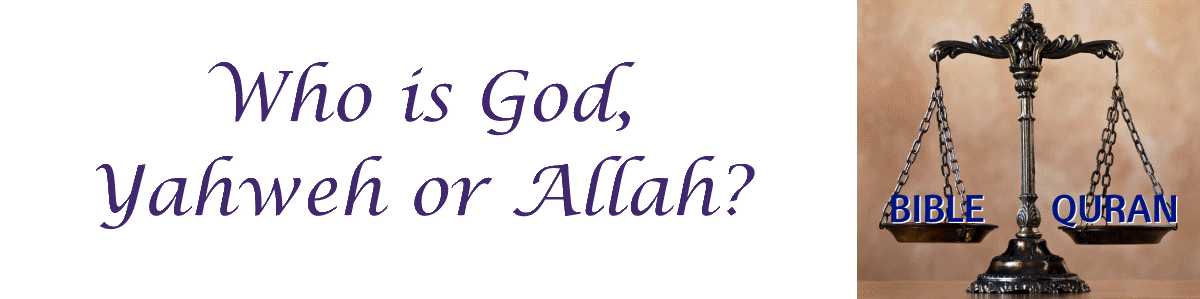
This study seeks to establish, beyond all doubt, who the true God is. Is it Yahweh, or is it Allah – or could it perhaps be both?
The two largest religions in the world are Christianity – of which the majority are Roman Catholic – and Islam. Yahweh is the God of Christians, and they acknowledge and worship Him as God. Muslims (Islam) worship Allah and regard him as the one true God. Islam does not recognise the Christian God as Yahweh. Instead, Muslims claim that the God of Islam and the God worshipped by Christians are the same God, and that His name is Allah. There are even many Christians who believe that Yahweh and Allah are the same God, and that these two faith communities essentially worship the same divine being.
It is therefore extremely important to determine whether these two beings are indeed the same person or deity. If they are not the same God, one must conclude that at least one of them is not the true God and is therefore a false god.
When one looks at creation, the benevolent love of the true Creator-God becomes visible. The God who created the universe, the world, and everything in it cannot be anything other than a God of love. When one considers the harmony of the earth in relation to the cosmos – the beauty, artistry, and delicate intricacy of what has been made: the universe, the earth, plants, animals, and humanity – one can see love reflected in it. Every creative person cares about his or her successful creations and feels pride and protectiveness toward them. How much more, then, should one expect a Creator-God to desire the well-being of His creation, and especially of humanity. Yet it can go well with God’s creature, the human being, only as long as he acknowledges and honours his God and remains in a relationship of love with Him. This must, however, be done freely and not under compulsion, otherwise it becomes not only meaningless but also loveless.
The fact that human beings possess free will is itself evidence of the Creator’s love. How loving would it be to create people who function mechanically or instinctively, like robots? Humans would not be able to perform good deeds or be obedient. Neither would they be able to commit evil or be disobedient. No meaningful relationship between the Creator and the people in His creation would be possible if humans lacked the ability to make decisions and choices.
If the true God were not a God of love, He could have created humans without the ability to choose freely. In that case, laws and commands would not have been necessary, for they would not have been capable of doing wrong. Alternatively, He could have created them with free will but then forced them violently to obey His commands and serve Him. This would be even more loveless. How just would it be for a God to create humans with free will and then compel them by force to serve Him?
It is therefore assumed – and this is the foundational premise of this study – that the primary moral attribute of the true God is love. Specifically, a benevolent, caring love, not a sentimental or emotional softness. Also that the love of a true Creator-God shall first and foremost be a benevolence, a caring concern, because it is directed toward the well-being of His creation.
One would expect that a true God, who is by nature loving, would give laws (that which He commands humanity to do) that amount to love and benevolence, or at the very least insist on loving actions toward fellow human beings as well as toward Himself. Such a disposition would be good and beneficial for others and would not pose a threat to anyone. A God of love would also be just. Love does not permit injustice. Therefore loveless behaviour ought to be punishable, and one may expect a God of love to punish such conduct.
These two beings – Yahweh of the Bible and Allah of the Qur’an – are introduced through their respective books. Yahweh is revealed through the Bible, and Allah through the Qur’an and, to a large extent, through the Hadith (the Hadith is explained in Chapter 2). Through these revelations, their character and attributes become clear. For the purposes of this study, the focus falls primarily on their moral attributes. If they are indeed the same God, they must at least share the same moral attributes. These moral attributes are clearly described in their respective books. The quotations used here leave no doubt about the character and nature of the moral attributes of these two beings.
This study will therefore examine the two religions, Islam and Christianity, in depth. It will consider what their holy books teach and the kind of lives their followers live as a result. The study is not concerned with people’s opinions about the religions, but with how the moral lives and actions of their followers are shaped by what they are taught in their respective sacred texts.
If, in the process, anything is said that causes offense, the reader is asked to believe that this is not the intention. The intention is simply to adhere to the truth, and it is unfortunately the case that truth sometimes hurts. Great care has been taken to present quotations faithfully, without bias, and in context. If the reader perseveres, he or she will come to see that the motive behind this book is love, and a sincere effort to seek and reveal the truth.
The reader is therefore invited to read it to the end, and, if necessary, verify the accuracy of the quotations from the sources, and then decide what he or she considers credible. It is unfortunately true that, just as not all Christians are fully aware of what the Bible teaches, there are likely also Muslims who are not fully aware of everything taught in the Qur’an and the Hadith. For this reason, some quotations from these books may come as a surprise to some readers, both Christian and Muslim.
For the sake of those who may not be familiar with Islam, a brief overview of Islam follows.